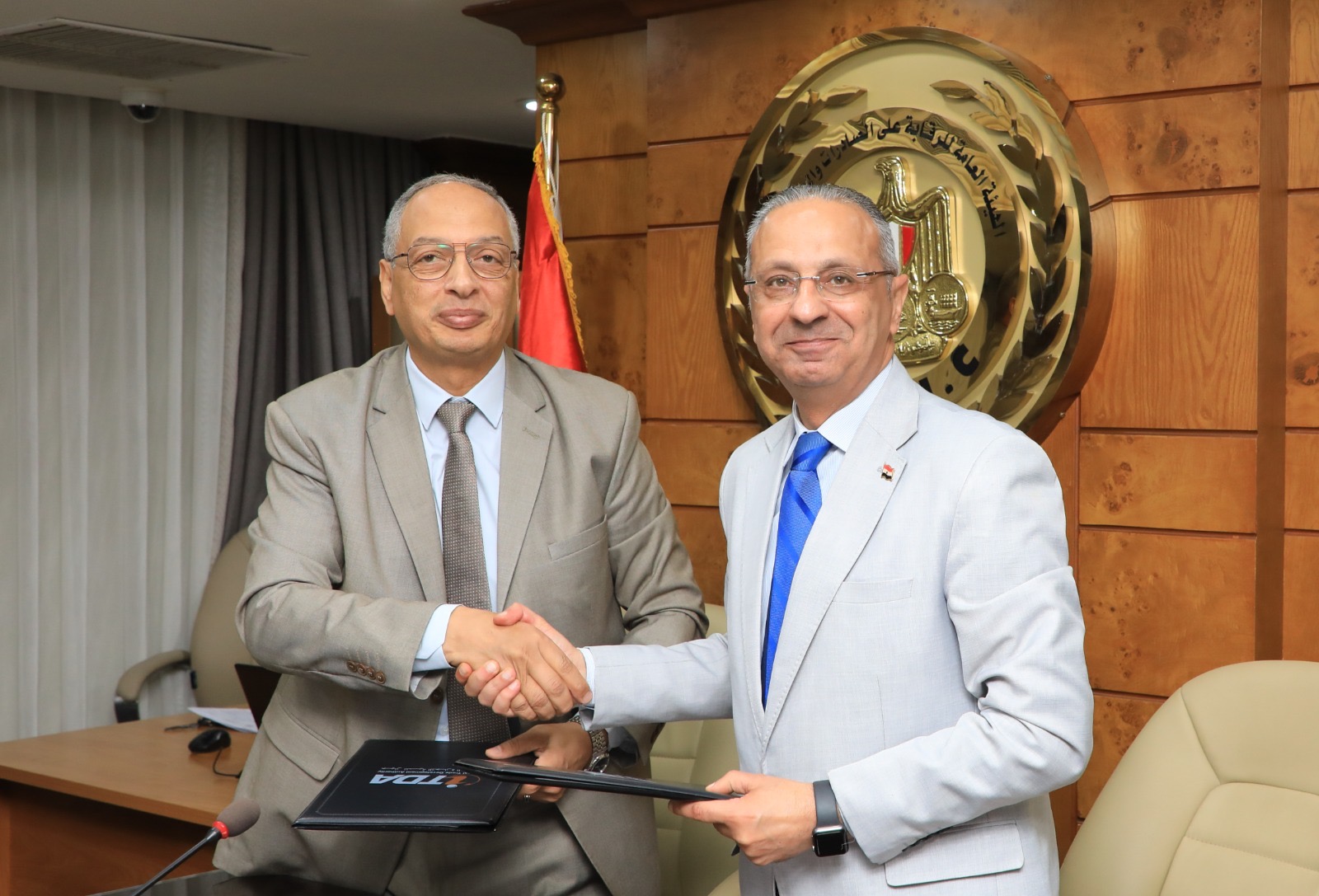
As a part of the State’s directions towards accelerating the pace of digital transformation and developing the government services, and in implementation of the policies of the Ministry of Investment and Foreign Trade aiming at facilitating trade and improving the business environment, the GOEIC and ITDA signed a Cooperation Protocol. This protocol aims at enhancing the institutional integration and developing mechanisms for exchanging data and information electronically between the two sides, in the presence of Engineer Essam El-Naggar, President of the GOEIC, and Major General Dr. Hossam El-Garahi, President of the ITDA
The protocol aims to achieve the full electronic connectivity between the GOEIC and the ITDA, enabling the immediate and secure exchange of data, contributing to raising the efficiency of the institutional performance, accelerating the completion of transactions, and providing more efficient services to investors and clients.
The cooperation includes providing the electronic verification services for registration certificates in the Commercial Agents Register and the Advertising and Publicity Register, in addition to verifying the validity of commercial register data electronically, which enhances the accuracy of the exchanged data and consolidates the principles of transparency and governance.
The protocol also includes providing the commercial registry data of companies registered with the Authority, which supports the continuous updating of databases, enhances information integration between the two parties, and contributes to supporting decision-making processes and raising the efficiency of the government work system.
The cooperation also allows for studying the provision of some services belonging to each entity through the outlets of the other entity, which makes it easier for citizens and investors to obtain government services through multiple channels, and reduces the time and effort required to complete transactions.
Both sides affirmed that the protocol represents a new step towards building an interconnected digital government system based on electronic data exchange, expanding the use of modern technologies, and reducing reliance on paper documents. This protocol supports improving the investment climate, enhances the business community’s confidence in the efficiency of government services, and contributes to providing faster, more accurate, and more flexible services in the next phase