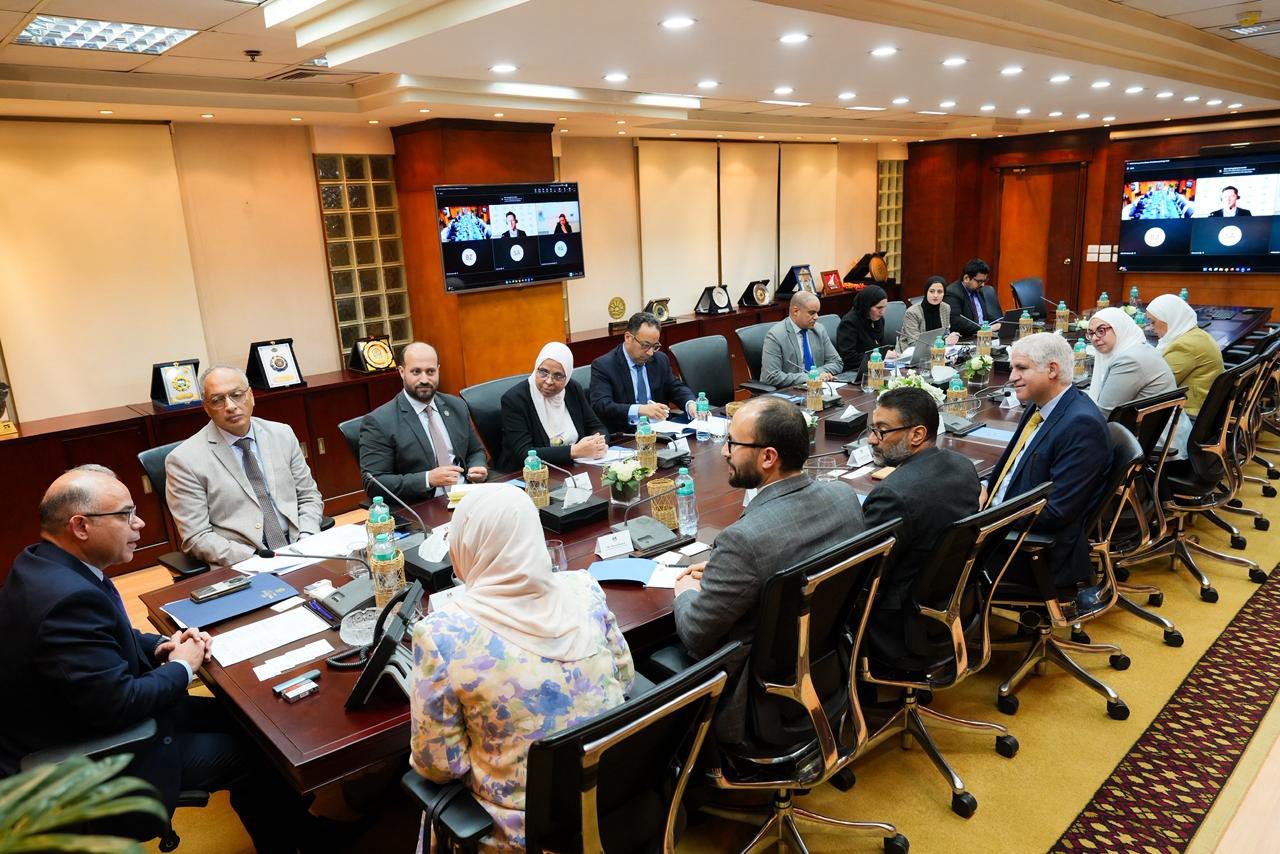
Dr. Mohamed Farid, Minister of Investment and Foreign Trade, held an extensive meeting with a delegation from the United Nations Industrial Development Organization (UNIDO), in the presence of Eng. Essam El-Naggar, President of the GOEIC, representatives of the organization, leaders of the Ministry and its affiliated authorities, and Dr. Jehan Bayoumi, Vice President of the organization in Egypt, to follow up on the execution of joint cooperation programs, and to discuss future strategies targeting the enhancement of the investment climate and development of Egyptian foreign trade until 2027.
Dr. Mohamed Farid affirmed that the Ministry of Investment and Foreign Trade, in light of the Egyptian state’s directives to enhance the competitiveness of the national economy, increase exports, and attract quality investments, pays a great attention to transforming the outputs of technical reports and studies implemented by the UNIDO into realistic and tangible action plans and executive policies, contributing to raising the efficiency of the targeted productive sectors and enhancing the competitiveness of the Egyptian product in international markets.
The Minister indicated that identifying points of strength and weakness in the sectors of high priority is a pivotal step to support the competitiveness of the Egyptian economy, explaining that Egypt currently has the largest portfolio of projects for the organization worldwide with 23 projects are in the pipeline, which reflects the confidence of international institutions in the ability of the Egyptian economy to grow, develop and move towards more competitive and sustainable production models.
Dr. Farid demonstrated that keeping pace with modern international requirements, especially the application of systems such as Digital Product Passport (DPP), has become an essential necessity to enhance the access of Egyptian exports to global markets, especially the European Union markets. He stressed that the Ministry is working in coordination with the UNIDO and the relevant authorities to qualify Egyptian entities to keep pace with the new environmental and digital requirements and the standards of the European Green Deal, in such way that supports the integration of digital technology into the production process and enhances Egypt’s attractiveness as a destination for quality investments directed towards export.
The digital product passport is an organized digital record for storing and exchanging essential information related to the product and its supply chain. The European Union is scheduled to begin its gradual implementation as of 2027 on specific priority product groups such as textiles and batteries, along with expanding the scope of application gradually to full implementation by 2030.
The Minister added that the partnership with the UNIDO is based on six main pillars, including the development of investment, trade and governance policies, investment promotion, green industry, smart cities, value chain development and innovation, stressing the importance of developing the quality infrastructure system in cooperation with the Egyptian General Authority for Standardization and Quality and the National Institute for Quality, to ensure the conformity of Egyptian products to the highest international standards and facilitate trade.
The meeting was attended by Engineer Essam El-Naggar, President of the GOEIC, within the framework of the GOEIC's pivotal role in supporting the quality infrastructure system, facilitating the foreign trade, and enhancing the readiness of Egyptian exports to access global markets, through the development of inspection and control mechanisms and conformity services in line with international standards and the requirements of the target markets.
On their part, officials from the UNIDO and the Trade, Industry, Growth and Rapid Market Access (TIGARA) Project supported and funded by the European Union reviewed the ongoing efforts to strengthen the investment and trade policy framework in Egypt through evidence-based analysis and institutional support, as well as improving the efficiency and governance of the quality infrastructure system and its compatibility with the international standards, which contributes to facilitating trade and market access, and accelerating digital transformation to keep pace with the changing requirements of global trade.
Representatives of the organization confirmed that the “TIGARA” project aims to raise the competitiveness of the private sector and create job opportunities, through the development of a number of promising industrial clusters in various governorates, and supporting their production and export capabilities.
Dr. Jehan Bayoumi, Vice President of UNIDO in Egypt, said that the organization’s partnership with Egypt is based on supporting a competitive, export-oriented industrial economy indicating that through the EU-funded “TIGARA” project, the organization is working with government partners to enhance the productive capacities of industrial clusters, support compliance with international standards, and integrate small and medium enterprises into global value chains.
She added that these efforts contribute to building a more flexible and future-ready trade system, which enhances Egypt’s position as a competitive player in international markets and supports the ability of Egyptian companies to access foreign markets.
At the conclusion of the meeting, Dr. Mohamed Farid directed the formation of joint technical working groups comprising representatives of the Ministry, relevant authorities, and the United Nations Industrial Development Organization (UNIDO), to work on scrutinizing the final formulas of the proposed policies and initiatives, and ensuring their rapid implementation on the ground, while generalizing the benefit from technical support and specialized training programs, especially with regard to making international databases available to exporters and investors, in a way that contributes to enhancing the readiness of Egyptian companies to access global markets, and consolidating Egypt’s position as a competitive export-based economy that attracts value-added investments.