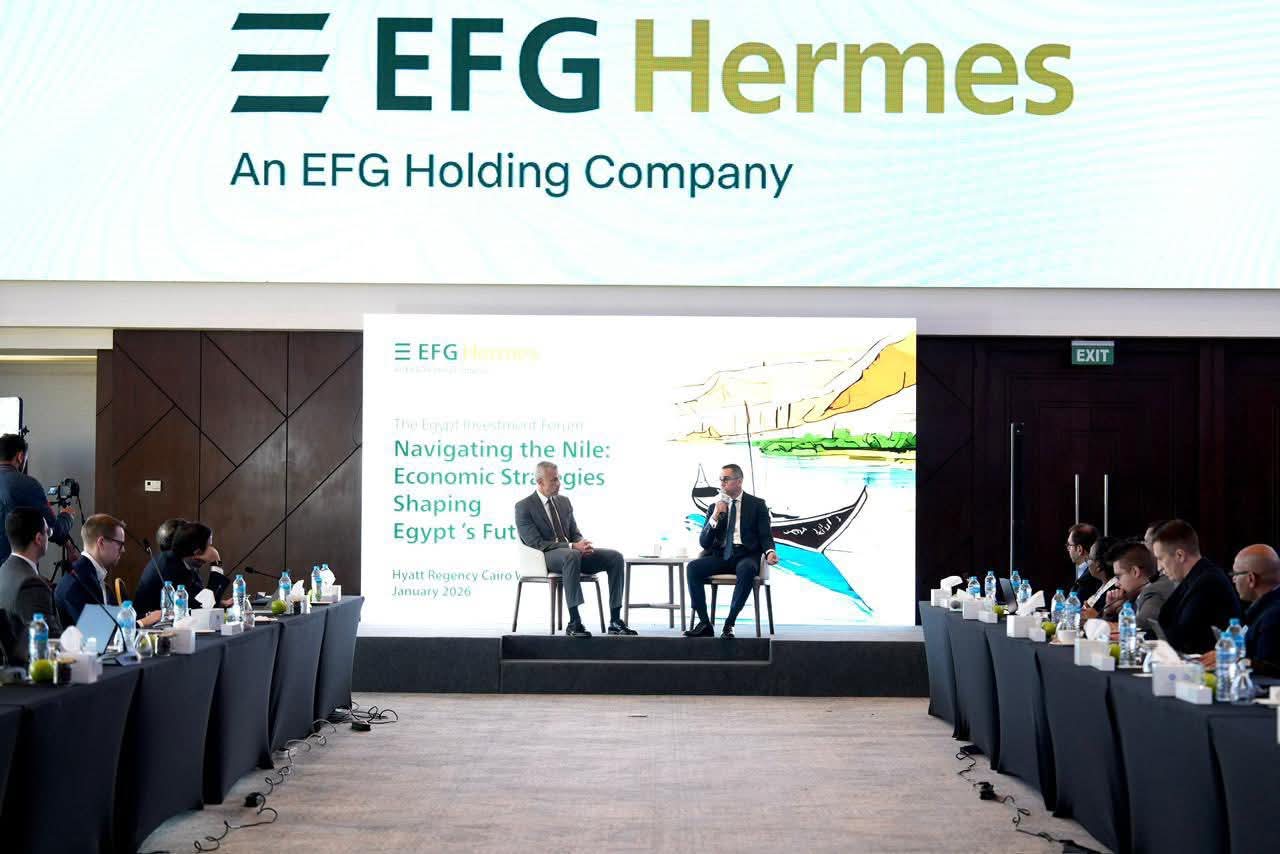
Hassan El Khatib, Minister of Investment and Foreign Trade, participated in a meeting of major global institutional investors, organized by EFG Hermes, the Investment Bank that affiliates to EFG Holding Group, a leader in the Middle East and North Africa markets, as part of the "Investment Forum in Egypt" activities. The meeting was attended by Karim Awad, CEO of EFG Holding Group, and a select group of leaders from international investment institutions. Ghada Nour, Assistant Minister of Investment for Investment, Promotion and Government Offerings, also attended the meeting.
At the beginning of the meeting, the Minister stated that Egypt had decisively moved from the stabilization phase to the implementation phase. With macroeconomic stability restored, the focus is now on competitiveness, export-led growth, and attracting private investment. These reforms are designed to support listed companies, deepen capital markets, and create sustainable long-term value for investors.
The Minister confirmed that the Egyptian government had set a clear priority during the past year to restore confidence in the national economy, as it is the basic entry point for moving to a stage of sustainable growth and enhancing competitiveness, explaining that the current economic policies are based on a logical sequence that begins with stability, passing with the reform, then the actual implementation, and finally achieving attractive returns for investment.
El Khatib indicated that Egypt has implemented huge investments in the infrastructure exceeding $550 billion, including the development of ports, road networks, logistics, energy and digital infrastructure, noting that these investments were not for the purpose of superficial expansion, but rather to address chronic structural bottlenecks, as the current stage focuses on enabling the private sector to maximize the return from this ready infrastructure.
The minister demonstrated that the economic reform program is based on four integrated pillars, including monetary policy, fiscal policy, and trade policy, in addition to redefining the role of the state as a regulator and enabler of economic activity, stressing that these pillars are being implemented simultaneously to ensure a real and sustainable impact on the investment climate.
With respect to the monetary policy, the Minister pointed out that the shift to inflation targeting was a pivotal step to restore credibility, which was reflected in the improvement of macroeconomic indicators, as net foreign assets turned into a surplus, remittances from Egyptians abroad reached about $36.5 billion, along with a decline in inflation rates to about 12% in November, and an increase in foreign reserves to nearly $50 billion, which contributed to restoring confidence and stabilizing the exchange market.
The Minister of Investment affirmed that the current fiscal policy, led by the Minister of Finance who is well aware of the magnitude of the challenges and how to address them, is based on achieving discipline without negatively impacting growth rates, through simplifying the tax system, resolving disputes, expanding digitalization, and setting a clear ceiling for public investments to ensure that the private sector is not crowded out. He explained that the goal is to reach a competitive effective tax rate that enhances investment attractiveness.
El Khatib referred that the government, for the first time, has conducted a comprehensive survey of all non-tax fees and charges, in order to address one of the biggest challenges facing investors, which is unexpected fees and multiple collection agencies, stressing that this step will contribute to reducing costs and time and raising levels of transparency.
Regarding the Trade Policy, the Minister indicated that it is considered as a key tool to support investment and export-led growth, adding that they are currently working on finalizing Egypt's trade policy document. He also noted that the last trade policy document was from 2002 and that their goal is to increase exports, as Egypt does not have a problem with imports. 85% of their imports are production inputs and 10% are essential goods, in addition to a percentage of imports that are also essential for some sectors such as tourism, as they aim to be among the top 50 countries worldwide. He said that in order to achieve the required increases in export figures, they are working on increasing Foreign Direct Investment and Domestic Investment by encouraging hundreds of companies to invest in Egypt.
He explained that customs release time has been reduced from 16 days to 5.8 days, with a target of reaching just two days by the first quarter of 2026, adding that these reforms have contributed to achieving savings estimated at about $1.5 billion so far, with expectations of rising to $2.1 billion when implementation is completed, along with the launch of a new export burden refund program based on clear rules and a commitment to payment within 90 days.
The Minister pointed out that we have many trade agreements that allow Egyptian exports access to many markets, and we have a clear plan for Africa, which represents an opportunity for Egypt to expand and increase its exports, and that Egypt’s location and current trade agreements represent an opportunity for Egypt to be the gateway for exports to Africa.
The minister indicated that the state has redefined its role in economic activity, stressing that it no longer competes with investors, through a state ownership policy that clearly defines areas of government presence and exit strategies.
Al-Khatib stressed that digital transformation is the main driver for implementing reforms, not just a formal procedure, noting that the Business Ready 2026 Program includes 209 reforms based on standards led by the private sector, adding that the launch of platforms such as the electronic licensing, the Egyptian Business Portal, and the National Trade Platform has contributed to unifying the investor’s journey and reducing overlap between different entities.
During the meeting, the Minister of Investment answered a number of inquiries raised by participants from the leadership of international investment institutions regarding the participation of the private sector and ways to attract more investments.
In such context, the Minister of Investment and Foreign Trade explained that we are currently achieving foreign direct investments averaging $12 billion annually, and our goal is to double the Volume of Foreign Direct Investment, which is not an easy task. We are working to support and encourage investment in important sectors, especially in the new and renewable energy sectors and the tourism and industry sectors, by creating the necessary climate to attract more investments through the development of the infrastructure network and the development of ports.
He explained that the North Coast Development Projects will help change the image of tourism in Egypt, pointing to the size of the major projects being implemented on the North Coast, which are based on partnership with the private sector and help create job opportunities and bring about the required development.