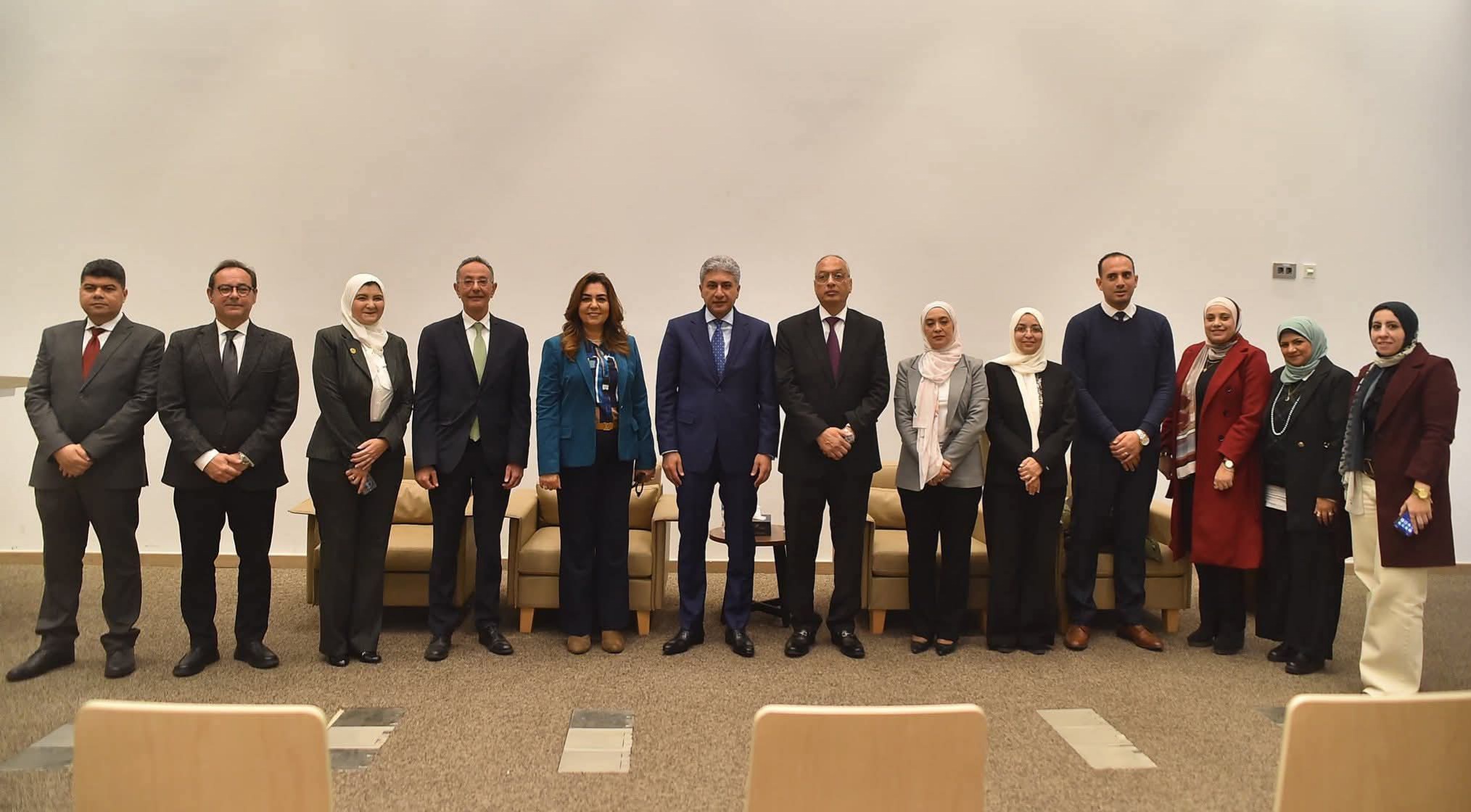
Dr. Manal Awad, Minister of Local Development and Acting Minister of Environment, and Mr. Sherif Fathy, Minister of Tourism and Antiquities, announced the success of the Ministry of Environment in achieving carbon neutrality for the Grand Egyptian Museum. This came after they received the carbon footprint report for the inauguration ceremony of the Grand Egyptian Museum, in preparation for declaring it as a carbon neutral facility, with the participation of Eng. Essam El-Naggar, President of the General Organization for Export and Import Control (GOEIC) on behalf of Eng. Hassan El-Khatib, Minister of Investment and Foreign Trade, Dr. Ahmed Ghoneim, CEO of the Grand Egyptian Museum Authority, Eng. Sherif Abdel Rahim, Assistant Minister for Climate Policies, and Dr. Saber Othman, Chief of the Central Department for Climate Change. This event is a practical embodiment of the Egyptian state's orientation towards a green economy and the promotion of sustainable development paths in accordance with Egypt's Vision 2030.
During her speech, Dr. Manal Awad affirmed that the experiment held today at the Egyptian Museum is the first experiment to apply the calculation of the carbon footprint in one of the national projects, in implementation of the directives of the political leadership, on the necessity of achieving carbon neutrality for national projects, which reflects the commitment of the Egyptian state to integrate the environmental dimension and climate action in planning and implementation of its major projects, and to enhance Egypt’s position as a leading country in adopting low-emission sustainable development paths.
Dr. Manal Awad confirmed the Ministry of Environment's efforts to achieve carbon neutrality for the museum, which confirms that the Egyptian state is not only committed to establishing world-class projects in terms of cultural and civilizational value, but also ensures that these projects comply with environmental sustainability standards and keep pace with best international practices. This confirms that climate action has become an integral part of the state's decision-making system, in line with Egypt's Vision for Sustainable Development 2030 and the National Climate Change Strategy 2050. She demonstrated that this step comes within the framework of joint cooperation between the Ministry of Environment, the Ministry of Tourism, and the Museum Administration, in preparation to generalize the experience on other national projects in the coming period.
Dr. Manal Awad added that the carbon neutrality environmental certificates issued by the Ministry of Environment and registered with the United Nations Secretariat represent an important addition to the tourism and investment sectors, and enhance Egypt’s international image as a country committed to environmental standards and concerned with environmental and climate sustainability.
Dr. Manal Awad pointed out that the Egyptian Museum is the first entity which environmental commitment is legally and officially documented according to international standards, through a report issued by an accredited national body. She noted that the certifications were the result of sustained efforts within the Ministry, and that these efforts complement the previously achieved carbon neutrality during the trial operation period of the Grand Egyptian Museum in 2023 and 2024, within the framework of the protocol signed between the Ministry of Environment and the Grand Egyptian Museum Authority. She emphasized the continuation of cooperation in the upcoming phase, with the Ministry of Environment fully prepared to provide the necessary technical and institutional support in this regard.
Dr. Manal Awad demonstrated that the success of these procedures is due to the efforts of the Ministry of Environment experts in creating credits of emission reduction units registered with the Secretariat of the United Nations Framework Convention on Climate Change (UNFCCC), resulting from Clean Development Mechanism Projects implemented on Egyptian land from 2005 to 2020, thus ensuring environmental integrity, credibility, transparency of this procedure.
On his part, Mr. Sherif Fathy, Minister of Tourism and Antiquities, affirmed that what we are witnessing today embodies a successful model of close cooperation and the spirit of joint work between three ministries, praising the environmental steps and procedures presented and the results that confirm that the opening ceremony of the Grand Egyptian Museum came with a low environmental impact in accordance with internationally accepted rates.
The Minister stressed the importance of environmental responsibility in general, and especially in the tourism and antiquities sectors, noting that the Egyptian state, represented by Ministry of Tourism and Antiquities, pays a great attention to applying the concepts of environmental sustainability in the tourism and antiquities sectors.
He also pointed out that some international tourism companies have announced that tourists, by 2030, will only go to destinations and facilities that apply clear environmental standards and requirements, stressing that the world is moving towards encouraging everything that is environmentally responsible.
Mr. Sherif Fathy explained that hotels in Sharm El Sheikh adhere to international environmental standards, noting that over 50% of hotels in Egypt already implement various environmental measures, including the use of clean energy sources, reduced plastic consumption, and other sustainable practices. He added that efforts are underway to further enhance these standards in the coming period. He also indicated that environmental regulations are being implemented in the diving centers and other tourist activities.
He added that there are five archaeological museums in Egypt, including the Sharm El-Sheikh Museum, in addition to a number of archaeological sites such as the Giza Pyramids area, that apply environmental requirements and rely on the use of clean energy sources, which contributes to preserving natural resources and supporting sustainable tourism.
The Minister of Tourism and Antiquities concluded his remarks by stating that Egypt is rich in distinguished talents that possess extensive experience in the field of sustainability and environmental responsibility, and he expressed his gratitude to the Ministers of Environment and Investment and the participating work teams from these ministries, in appreciation of their efforts and fruitful cooperation that contributed to achieving the positive results we witnessed today.
Engineer Essam El-Naggar, President of the GOEIC, said that this cooperation is clear evidence of the strategic shift in GOEIC's role, that has become a key partner in supporting the state’s environmental policies and a technical guarantor of Egypt’s international commitments in confronting climate change, through the Environmental Validation and Verification Unit (EVVU), which is one of the leading national bodies qualified to conduct this type of advanced environmental verification process.
He added that these operations comprised two main axes. The first involved verifying the carbon emissions of all the museum's operational activities during the two-year trial period, ensuring the accuracy and reliability of the environmental data. The second axis involved conducting accurate audits of the predictable and actual carbon emissions associated with the official inauguration ceremony to guarantee that this global event reflects the Egyptian state's commitment to organizing major events according to sustainability principles, and to present the Grand Egyptian Museum to the world as a model for the concept of a green museum.
On his part, Dr. Ahmed Ghoneim ensured that receiving the carbon footprint verification report today for the inauguration ceremony of the Grand Egyptian Museum is not a mere formality, but rather represents a clear message that this major national event was organized according to a precise methodology for measuring the resulting emissions, reflecting the museum's commitment to adopting a responsible approach in managing major events, and in line with the objectives of Egypt's Vision 2030 in the areas of sustainability and climate action. He also thanked Dr. Shaimaa Eid, the museum's sustainability officer, for her efforts in supporting the museum in the sustainability file.
He also stressed that the Grand Egyptian Museum does not only obtain green building certificates, but also it seeks to be a platform for environmental awareness and to establish this approach as part of the institutional work philosophy, through adopting environmentally friendly operational practices, providing educational content that establishes a culture of sustainability among visitors, and working continuously through joint technical committees to ensure the sustainability of this direction, stressing that the Grand Egyptian Museum renews its commitment to continue working according to this approach, believing that preserving heritage is inseparable from protecting the environment, and that institutional partnership is the way to achieve sustainable development befitting Egypt’s status and history.
At the conclusion of this event, the attendees affirmed that the Grand Egyptian Museum welcomes its visitors from all over the world not only as the largest museum of antiquities in the world, but also as a national and global model that combines the preservation of human heritage with a commitment to environmental standards, confirming that preserving history can go hand in hand with protecting the planet.