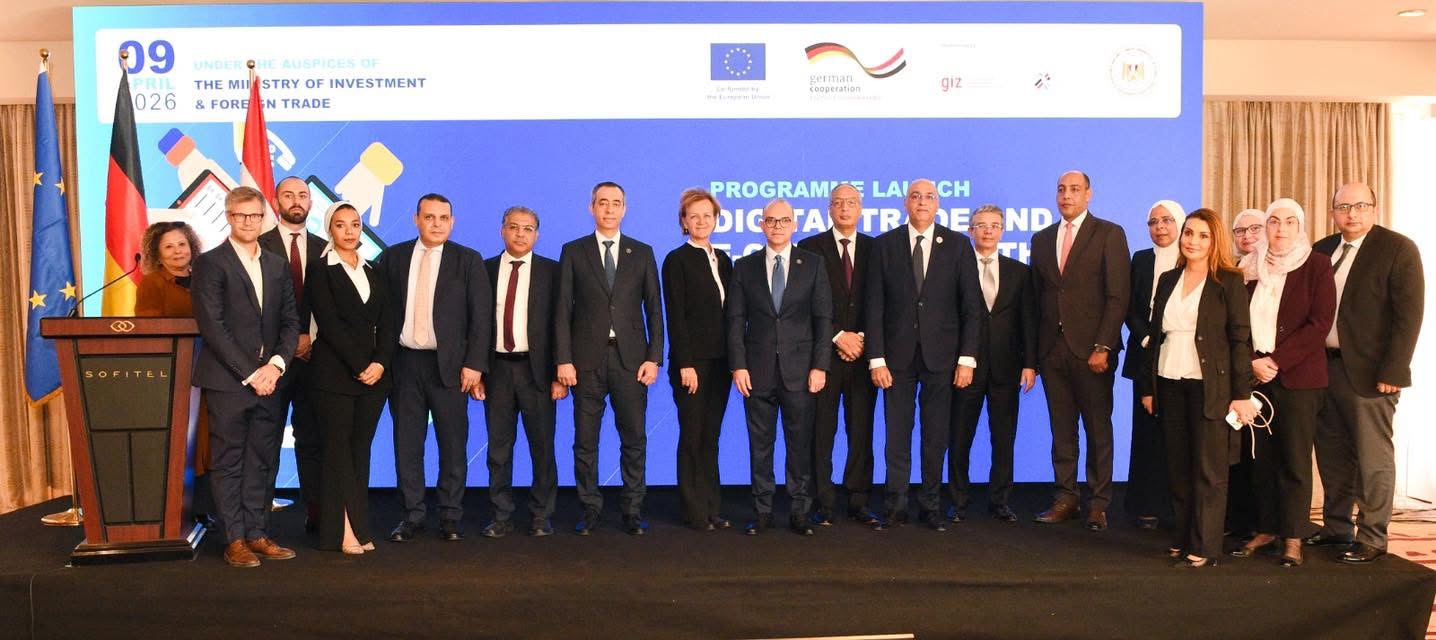
Dr. Mohamed Farid Saleh, Minister of Investment and Foreign Trade, participated in the launch of Regional Digital Trade and E-commerce Program in the Middle East and North Africa region, with the participation of Ms. Angelina Eichhorst, the European Union Ambassador to Arab Republic of Egypt in addition to a number of representatives of international institutions and development partners, within the framework of supporting Egypt's efforts towards digital transformation and enhancing intra-regional trade.
Launching this program comes in light of Egypt's policy aimed at developing the foreign trade system, enhancing the competitiveness of the national economy, and creating a business environment that stimulates investment, in line with the government’s directions towards digital transformation and raising the efficiency of institutional performance.
The program is jointly funded by the European Union and the German Federal Ministry for Economic Cooperation and Development (BMZ), and is implemented through the German Agency for International Cooperation (GIZ) and the International Trade Centre (ITC), aiming to build an integrated environment that supports digital trade in the region.
The program is based on a number of key pillars, including developing regulatory and strategic frameworks, implementing digital trade tools such as electronic payments and signatures, facilitating trade procedures, empowering the private sector, and enhancing regional cooperation, contributing to creating new business opportunities and increasing employment rates.
Dr. Mohamed Farid Saleh confirmed that launching the program represents an important step towards strengthening regional economic integration, referring that this approach comes as an extension of the structural reforms track implemented by the State to improve the business environment and develop the digital infrastructure.
The minister explained that the digital transformation plays a pivotal role in modernizing value chains and facilitating cross-border trade, noting that the expansion of internet and mobile phone services has contributed significantly to supporting the growth of digital trade.
He also stressed the importance of enhancing trust in the digital commerce environment by implementing electronic identity verification (eKYC) systems, that are considered a key element in reducing risks associated with digital transactions, in addition to activating digital contracts and developing electronic dispute resolution mechanisms, in such way that supports the stability of this vital sector.
In a related context, the minister referred to the ministry’s direction towards adopting modern technologies, especially the Artificial Intelligence, to support the digital trade, through creation of an experimental regulatory environment for trade technology (Trade Tech Sandbox), that supports the startups and enables them to develop innovative solutions based on data analysis.
He stressed that building human capacities is the cornerstone for ensuring the success of these initiatives, emphasizing that turning plans into a tangible reality requires qualified personnel capable of efficient implementation, which will lead to increased Egyptian exports and enhanced competitiveness of the national economy.
On her part, Ms. Angelina Eichhorst, the European Union Ambassador to Egypt, affirmed that the European Union is committed to supporting Egypt in maximizing the benefit of digital trade potentials, working to open new horizons for business, enhancing competitiveness, and creating cross-border opportunities, that contributes to achieving common prosperity for the countries of the region.
The event witnessed the participation of a number of relevant national entities, including Ministry of Communications and Information Technology, Egyptian Customs Authority, General Organization for Export and Import Control, Personal Data Protection Center, Information Technology Industry Development Agency, and Enterprises Development Agency (MSMEDA), in addition to representatives of the Private Sector, within the framework of strengthening institutional integration and supporting the State’s efforts in developing the foreign trade system.