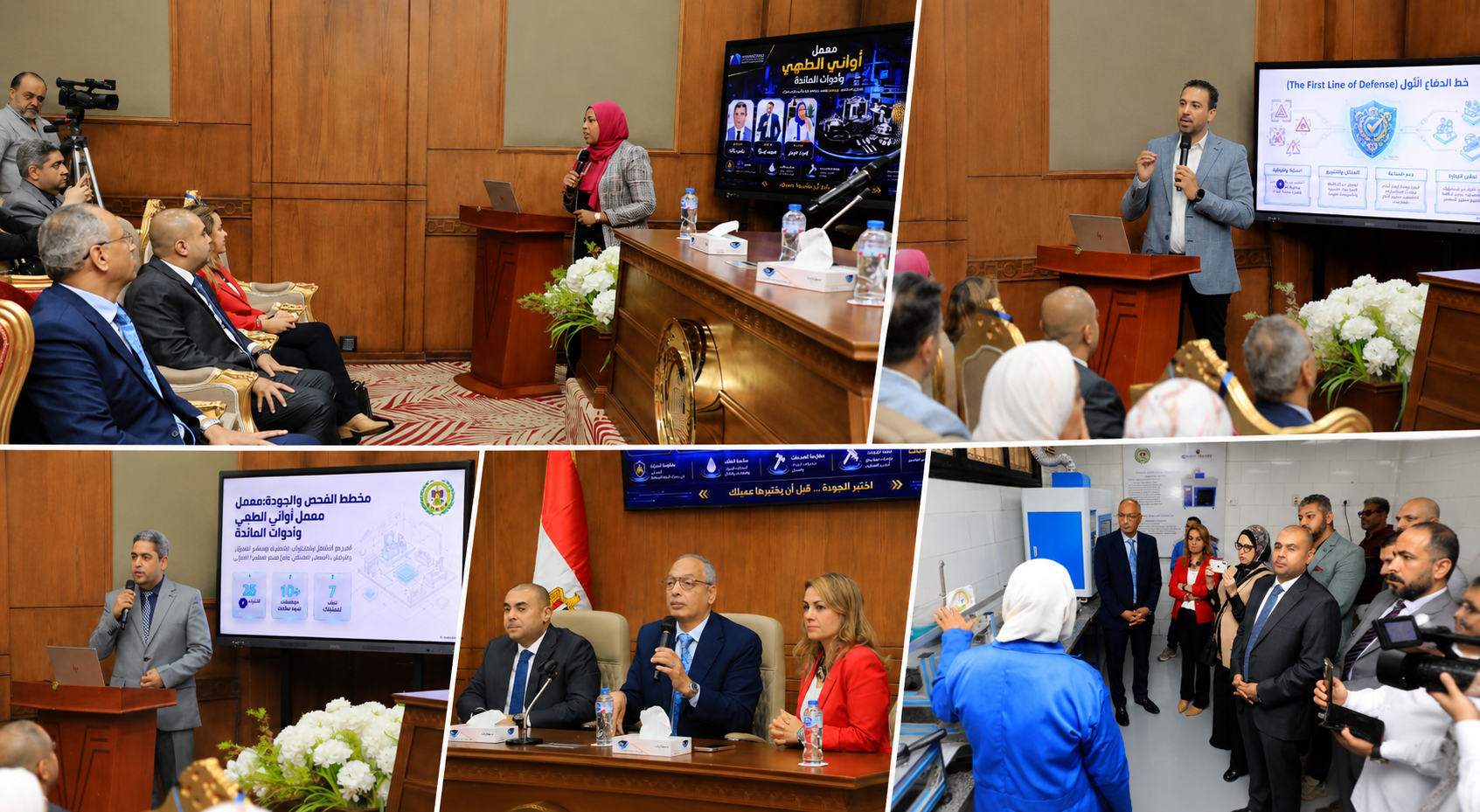
Within the framework of the directives of the Ministry of Investment and Foreign Trade to develop the inspection and testing system and raise the efficiency of the technical laboratories affiliated with the General Organization for Export and Import Control(GOEIC), the GOEIC inaugurated the Cookware and Tableware Laboratory at Cairo International Airport Branch, as part of GOEIC's plan to expand the establishment and development of specialized laboratories, in such way that enhances its capability to inspect goods and the products traded in the markets according to the latest technical references.
Inaugurating the laboratory is an implementation of the directives of Dr. Mohamed Farid, Minister of Investment and Foreign Trade, with respect to the importance of upgrading the technical control system on goods, and supporting the efficiency of GOEIC's laboratories as one of the main tools to ensure the quality of products, protect the consumer, facilitate trade, and enhance confidence in goods that conform to the standard.
The laboratory is considered as an important addition to GOEIC's industrial laboratory system, as it concerned with examining cooking utensils, tableware, and food contact products. Its role is not limited to evaluating the external appearance or apparent manufacturing quality only, but extends to verifying the safety of raw materials, fastness of paint layers, durability of handles and grips, heat resistance, and the suitability of the product for safe use and direct contact with food.
The scope of the laboratory's work includes examining cookware used on the stove or inside the oven, tableware and utensils, stainless steel cookware, covered and uncovered aluminum cookware, cookware coated with non-stick layers such as Teflon, ceramic and granite, as well as enameled cast iron cookware, pressure cookers, non-electric refrigerators and kettles, and stainless steel tableware.
In its inspection and testing work, the laboratory relies on a set of Egyptian, European and international technical specifications, which specify testing requirements, measurement methods, and acceptance and rejection limits for each type, ensuring the issuance of accurate technical results and conformity decisions based on clear standard foundations.
The sample journey begins, inside the laboratory, with the stage of receiving and recording data, then determining the type of product and the standard specification applied to it, and selecting the appropriate tests according to the nature of the sample, before carrying out standard and specialized tests until the technical decision is issued to accept or reject it.
The laboratory conducts a number of basic tests, including dimensional measurement, thickness measurement, determination of liter capacity, leakage testing, and hand durability testing, which helps in forming an accurate technical assessment of the product's quality and the accuracy of its manufacturing.
The laboratory also includes specialized tests directly related to safe use, including heat resistance, fire resistance, thermal insulation of non-metallic handles, bending resistance tests, impact strength, fatigue under repeated loads, and torsional torque resistance, to ensure that the handles, grips, and fastening systems can withstand actual usage conditions without separation, damage, or deformation.
Regarding non-stick coated cookware, thorough tests are conducted on the inner surface contacting with food. These tests include coating hardness, scratch resistance, visual inspection for defects, and the use of an optical microscope to detect visible scratches or defects. This helps ensure the stability of the coating and prevents it from being damaged quickly during use.
Special tests are also carried out to assess the fastness of the container's surface after thermal shock, by exposing it to repeated heating and cooling cycles and measuring any changes that may occur to the surface or bottom, reflecting the product's ability to endure daily usage conditions without any deformation affecting its performance or safety.
Engineer Essam El Naggar, Chairman of the GOEIC, confirmed that inauguration of the cookware and tableware laboratory comes within the framework of GOEIC's plan to develop its laboratory infrastructure and raise the efficiency of inspection and testing services, in line with the Ministry’s policy of protecting the consumer, supporting product quality, facilitating trade, and enhancing the competitiveness of products that conform to specifications.
He demonstrated that the laboratory represents an important step in supporting the technical control system for food contact products, especially in light of the direct link between these products and the consumer's health and safety, stressing that the GOEIC is continuing to update its laboratories and provide them with the necessary technical capabilities to ensure the accuracy and speed of inspection procedures.
The inauguration of the laboratory enhances the integration of the inspection system inside the GOEIC as a number of supporting laboratories can be used when necessary, including the spectroscopic analysis laboratory to verify the chemical composition of metal alloys, and the electrical safety laboratory in case of electrically powered products, consequently ensuring the evaluation of the product from all technical aspects related to quality and safe use.
This integrated testing system contributes to supporting the consumer, the manufacturer, the importer, and regulatory authorities by providing accurate technical results that help improve product quality and make acceptance or rejection decisions based on clear standard measurements and tests.
Inauguration of the Cookware and Tableware Laboratory at the Cairo International Airport branch confirms GOEIC's commitment to strengthening the role of its technical laboratories in protecting the consumer, ensuring product quality, and raising the level of confidence in goods traded in the markets, thus supporting the delivery of a safe, conforming product that is able to perform its function efficiently to the consumer.