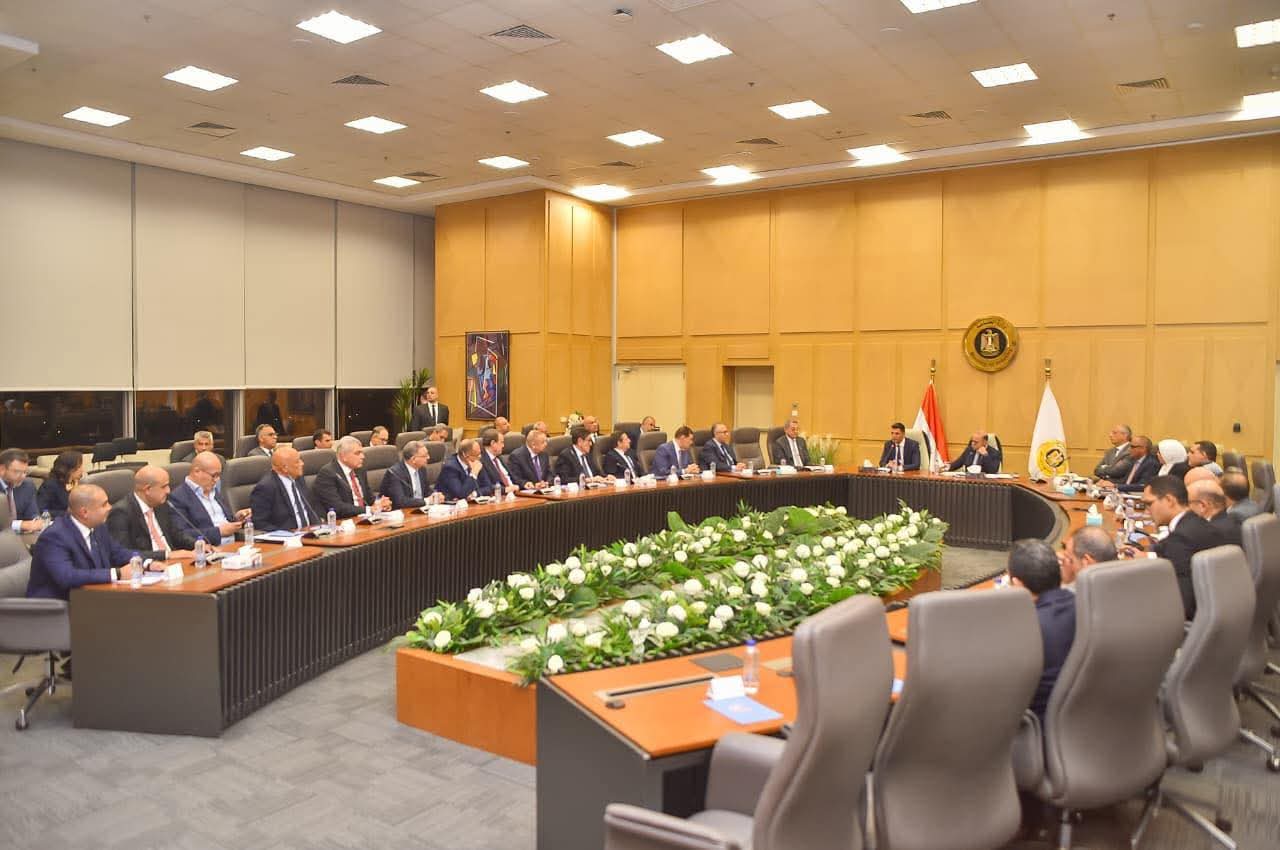
Dr. Mohamed Farid, Minister of Investment and Foreign Trade, and Eng. Khaled Hashem, Minister of Industry, held an expanded meeting that lasted four continuous hours with the heads of (13) export councils and officials of the relevant authorities and entities, within the framework of the state’s direction to restructure exports development system and link it to clear quantitative targets that enhance the competitiveness of the national economy, support employment and attract foreign direct investments.
The meeting comes just 72 hours after the swearing-in ceremony, reflecting the priority given to the export file within government's work agenda during the next phase, and consolidating the principle of effective partnership between the state and the private sector.
The meeting witnessed intensive technical discussions to set the executive foundations for a new phase in managing the export file, based on linking incentives to specific Key Performance Indicators (KPIs) for each sector, which are measurable and subject to periodic monitoring.
Dr. Mohamed Farid stressed that the next phase is based on a clear principle: “No incentives without verifiable, measurable and controllable digital targets,” confirming that burdens rebate programs will be linked to actual growth rates, an increase in production capacity, higher employment rates, and specific plans to penetrate new markets.
He explained that the meeting is foundational, and will be followed by a number of specialized meetings with each export council separately to agree upon specific figures, implementation mechanisms, and clear schedules for monitoring and evaluation.
The Minister added: "Today's meeting is a head start towards a future based on implementation and accountability according to the targets and there's not a magic wand as changing the reality in the real economy requires practical visions and targets that can be measured and implemented."
He indicated that the ministry will work to strengthen the link between the financial sector, both banking and non-banking, and both sectors of industry and export, in order to get the benefit from innovative financing solutions, while holding meetings soon that bring the two sides together to support production expansion plans.
He also demonstrated that the comprehensive plan for developing exports includes expansion in trade missions and exhibitions, motivating export-oriented manufacturing, developing export burdens rebate programs, attracting new investments to increase production capacity, and open new markets, especially in Africa, along with focusing on high value-added industries.
On his part, Engineer Khaled Hashem, Minister of Industry, affirmed that the ministry is working to deepen local manufacturing and increase the proportions of local components within production chains, which will raise the competitiveness of Egyptian products and reduce the import bill, indicating that the next stage will witness close coordination with export councils to develop quick and executive solutions for each sector.
He explained that the target enables factories to expand and increase production with higher quality and more competitive costs. This accordingly supports access to foreign markets and enhance industry's contribution to the economic growth and creating job opportunities.
The meeting witnessed submitting a number of sectoral proposals, including supporting the electric vehicle industry, developing production lines in printing sector, attracting long-term investments for medical industries, as well as managing foreign competition with more efficient mechanisms in the spinning and weaving sector.
The importance of launching specialized training centers for footwear sector, developing automated slaughterhouse system, modernizing the Rubiki factories, and strengthening international partnerships in the fields of fashion and leather industries was also emphasized, as well as developing the quarry system to support agricultural export industries and building materials.
The meeting was attended by officials from agencies and bodies affiliated with the Ministry of Investment and Foreign Trade, including the General Organization for Export and Import Control (GOIEC), Egypt Expo & Convention Authority (EECA), and the Trade Representation Authority, in addition to heads and members of the export councils for various industrial and agricultural sectors.
The participants agreed that the meeting represents a starting point for a different phase in managing export file, based on specific figures, clear timetables, and precise follow-up mechanisms, in order to achieve a qualitative leap in Egyptian exports during the coming years.